DUMBO and Cobble Hill sit just a few blocks apart in northwest Brooklyn, but they offer buyers radically different lifestyles. If you are a real estate agent working either neighborhood, understanding those differences is the key to matching buyers, pricing listings correctly, and marketing properties that actually sell. DUMBO commands some of the highest condo prices in Brooklyn, with median sales regularly landing between $1.5 million and $2.5 million or more. Cobble Hill, by contrast, blends family-oriented brownstone living with more accessible condo inventory in the $800K to $1.5 million range. Together, these two neighborhoods represent the premium tier of Brooklyn real estate, and agents who master both can capture a larger share of high-value transactions.
DUMBO: Brooklyn’s Most Expensive Neighborhood
DUMBO (Down Under the Manhattan Bridge Overpass) has earned its reputation as one of Brooklyn’s priciest zip codes, and the numbers back it up. The neighborhood’s median condo price hovers between $1.5 million and $2.5 million, with luxury penthouses and waterfront units pushing well past $3 million. Price per square foot regularly exceeds $1,400, placing DUMBO among the most expensive residential markets in all of New York City.
The housing stock is what makes DUMBO distinctive. Converted warehouses and lofts define the neighborhood’s character, with soaring ceilings, oversized industrial windows, exposed brick, and open floor plans that attract design-conscious buyers. Buildings like 1 Main Street, 30 Washington Street, and the Clocktower Building are iconic addresses that carry serious cachet.
Newer luxury developments have added a modern layer to the market. Olympia at 30 Front Street is the most prominent recent addition, a two-tower development with over 800 units, a full suite of amenities, and pricing that starts around $1 million for one-bedrooms and climbs past $4 million for larger units. Other notable developments include Dumbo Heights and 168 Plymouth Street.
For agents listing in DUMBO, this blend of historic conversions and modern luxury means you need to understand two very different buyer conversations. The loft buyer wants character, authenticity, and architectural details. The new development buyer wants amenities, finishes, and convenience. Both want the views.
What Sells DUMBO: The Key Differentiators
The selling points in DUMBO are visual, tangible, and unique to this neighborhood. Agents who lean into these advantages consistently outperform those who rely on generic Brooklyn marketing.
Manhattan Bridge and Brooklyn Bridge views are the crown jewels. A listing with an unobstructed bridge view can command a 15% to 25% premium over a comparable unit without one. When you are writing listing descriptions or planning your photography, the bridge views should be front and center. Twilight shots of the bridges lit up at night are some of the most powerful listing images in all of Brooklyn.
Brooklyn Bridge Park stretches 85 acres along the waterfront and has transformed DUMBO’s livability. Playgrounds, sports facilities, Pier 6 beach, Jane’s Carousel, and green space give buyers (especially families) a direct answer to the “where do you go outside?” question. Properties within a 5-minute walk of the park entrance see measurably stronger demand.
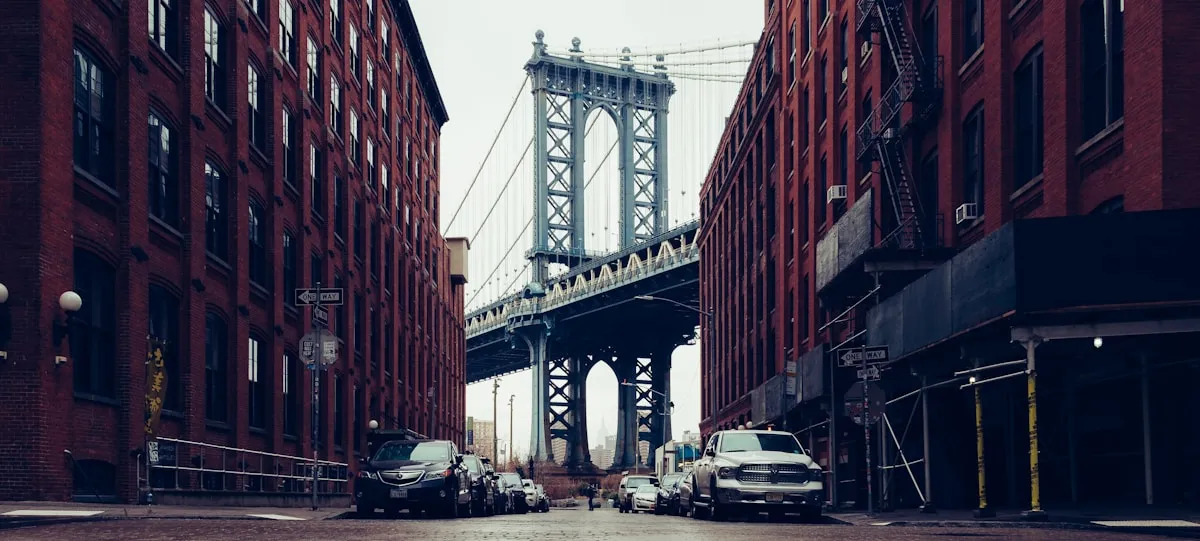
Cobblestone streets and the neighborhood’s industrial aesthetic create an atmosphere that photographs exceptionally well. The intersection of Washington Street and Water Street, with the Manhattan Bridge framed between brick buildings, is one of the most photographed spots in New York City. That visual identity translates directly into listing marketing. When buyers picture themselves in DUMBO, they are picturing that exact scene.
Tech and creative offices bring daytime energy and a built-in buyer pool. Etsy’s headquarters, WeWork’s early offices, and a concentration of tech startups mean that many DUMBO buyers work within walking distance of their homes. This is a genuine lifestyle selling point: a 5-minute commute is rare in New York City.
DUMBO Buyer Profiles
Understanding who buys in DUMBO helps agents target their marketing, choose the right platforms, and frame the right conversations during showings.
Tech professionals represent a significant portion of the buyer pool. These buyers tend to be in their late 20s to early 40s, earning between $200K and $500K annually, and they prioritize design, convenience, and walkability. They respond to modern finishes, smart home features, and proximity to their offices. Marketing to this group means strong digital presence, high-quality visuals, and listing descriptions that emphasize the neighborhood’s innovation culture.
Finance professionals working in Manhattan’s Financial District or Midtown are drawn to DUMBO by the short commute. The F train from York Street to Wall Street takes roughly 12 minutes, and the NYC Ferry offers a scenic alternative that lands at Pier 11. These buyers tend to have higher budgets and prioritize space, views, and building amenities.
Empty nesters downsizing from Manhattan represent a growing segment. These buyers are selling three-bedroom apartments on the Upper East Side or Upper West Side and purchasing premium one or two-bedroom units in DUMBO, often with substantial budgets. They want cultural amenities, walkability, and a neighborhood that feels vibrant without the density of Midtown. The luxury listing marketing guide covers the specific strategies that resonate with this demographic.
International buyers and investors are also present, drawn by DUMBO’s brand recognition and strong rental demand. Rental yields in DUMBO run approximately 3% to 4% for condos, which is competitive for a premium Brooklyn location.
Cobble Hill: Brooklyn’s Family-Friendly Premium Market
Cobble Hill operates in a completely different register than DUMBO. Where DUMBO sells spectacle and skyline, Cobble Hill sells charm, community, and the feeling of living in a real neighborhood. The boundaries are compact: roughly Atlantic Avenue to the north, the BQE to the west, Degraw Street to the south, and Court Street to the east.
The housing stock is dominated by 19th-century brownstones and townhouses, and these are the prizes of the Cobble Hill market. Full brownstones trade between $2 million and $4 million depending on condition, size, and specific block. A fully renovated four-story brownstone on a prime tree-lined block can push past $4.5 million. The landmark district designation (covering most of the neighborhood) preserves the architectural character and provides a level of predictability that buyers value.
Condos and co-ops offer entry points between $800K and $1.5 million, with one-bedroom units in smaller conversions starting around $650K. The condo stock is mostly in converted townhouses and smaller buildings rather than large-scale developments. This keeps the neighborhood’s low-rise character intact and appeals to buyers who specifically want to avoid the big-building lifestyle.
Days on market in Cobble Hill average 40 to 55 days for well-priced listings, though prime brownstones in excellent condition can move faster. Inventory is consistently tight, with fewer than 50 active listings at any given time. That scarcity drives competition and supports pricing.
What Sells Cobble Hill: Neighborhood Charm as a Product
Cobble Hill’s selling points are less about individual property features and more about the neighborhood experience. Agents need to sell the lifestyle as aggressively as they sell the property itself.
Tree-lined streets and architectural beauty are the neighborhood’s calling card. Blocks like Strong Place, Tompkins Place, and Cheever Place are among the most picturesque residential streets in all of New York City. When listing a property in Cobble Hill, your photography should capture the streetscape, not just the interior. A shot of the brownstone facade framed by mature trees communicates more about the lifestyle than any floor plan.
The dining and shopping scene anchors daily life. Court Street and Smith Street are the two main commercial corridors, packed with independent restaurants, cafes, and boutiques. Grocery options include the iconic Sahadi’s and Stinky Bklyn for specialty foods, plus mainstream options nearby on Atlantic Avenue. For buyers coming from Manhattan, the variety and quality of Cobble Hill’s restaurants is a genuine surprise.
Schools and family infrastructure are a decisive factor for the neighborhood’s primary buyer demographic. Cobble Hill is zoned for PS 29 (John M. Harrigan), which carries a strong reputation and GreatSchools ratings consistently above 8 out of 10. The presence of good public school options, combined with access to Brooklyn’s network of private schools, makes Cobble Hill one of the most family-friendly neighborhoods in the borough.
Transit access is solid if not spectacular. The F and G trains at Bergen Street and Carroll Street stations provide service to Manhattan and other parts of Brooklyn. The commute to Midtown takes approximately 30 to 35 minutes, which is longer than DUMBO’s commute but acceptable for most buyers. Proximity to Downtown Brooklyn (a 10-minute walk) provides access to additional transit options.
Cobble Hill Buyer Profiles
The Cobble Hill buyer is distinct from the DUMBO buyer, and recognizing the differences will sharpen your approach.
Young families with children are the dominant buyer group. These are typically dual-income households earning $300K to $600K combined, often purchasing their first home after renting in the neighborhood or nearby areas like Brooklyn Heights or Park Slope. They prioritize outdoor space (backyards, roof decks), proximity to schools, and a sense of community. They are willing to pay a premium for a turnkey-renovated brownstone because they do not have the bandwidth to manage a renovation with young kids.
Professionals upgrading from smaller apartments represent another key segment. These buyers may be moving from a one-bedroom in DUMBO, Williamsburg, or Brooklyn Heights into a larger space as their needs change. They know Brooklyn well and are making a deliberate choice for Cobble Hill’s neighborhood character over newer, flashier options.
Buyers from Manhattan seeking more space for the same budget are a growing segment. A three-bedroom apartment on the Upper West Side might cost $2.5 million to $3.5 million. For the same money, a Cobble Hill brownstone offers dramatically more space, a private garden, and a neighborhood that rivals the best of Manhattan’s residential areas. This comparison is a powerful tool in buyer consultations.
The Brooklyn neighborhoods guide for agents provides additional context on how Cobble Hill compares to adjacent neighborhoods like Brooklyn Heights, Carroll Gardens, and Boerum Hill.
DUMBO vs. Cobble Hill: A Side-by-Side Comparison
Agents often encounter buyers considering both neighborhoods, so having a clear comparison framework is essential.
Price points diverge significantly. DUMBO’s median condo price of $1.5 to $2.5 million is substantially higher than Cobble Hill’s condo range of $800K to $1.5 million. However, Cobble Hill’s brownstones at $2 to $4 million overlap with DUMBO’s upper condo market, creating a genuine choice for buyers in that budget range: a luxury condo with views and amenities, or a brownstone with space and character.
Lifestyle differences are the real deciding factor. DUMBO buyers prioritize views, walkability to waterfront parks, proximity to tech offices, and a modern aesthetic. Cobble Hill buyers prioritize tree-lined residential streets, family infrastructure, dining options, and a traditional neighborhood feel. Neither is better; they serve fundamentally different needs.
Investment considerations also differ. DUMBO condos offer stronger rental yields (approximately 3% to 4%) and greater liquidity because the condo market is more active. Cobble Hill brownstones are long-hold assets that appreciate steadily but are less liquid due to higher price points and a smaller buyer pool at the top of the market.
Marketing approach must reflect these differences. DUMBO listings demand dramatic visual content: drone shots of the bridges, twilight photography, video walkthroughs that showcase the views. Cobble Hill listings benefit from warm, lifestyle-oriented content: the brownstone facade in autumn, the backyard garden, the walk to the neighborhood cafe. In both cases, professional photography is non-negotiable at these price points.
Marketing Strategies for Both Neighborhoods
Selling premium Brooklyn real estate requires more than a listing on the MLS. Here are the strategies that move properties in DUMBO and Cobble Hill.
For DUMBO listings, invest heavily in visual marketing. Budget for twilight photography, drone shots (the aerial view of the Manhattan and Brooklyn Bridges is one of the most powerful images in real estate marketing), and a professionally produced video walkthrough. Stage the unit to emphasize the views. If the listing has bridge or skyline views, every piece of marketing should lead with that visual. Social media advertising on Instagram and Facebook performs exceptionally well for DUMBO properties because the visuals are inherently shareable.
For Cobble Hill listings, focus on storytelling and neighborhood context. Your listing description should paint a picture of daily life: the morning walk to the cafe on Court Street, the kids playing in Cobble Hill Park, the weekend farmers market. Photography should include exterior shots of the tree-lined street, the brownstone facade, and any outdoor space. Floor plans are particularly important for brownstones because buyers need to understand the vertical layout across multiple floors.
For both neighborhoods, price correctly from day one. At these price points, overpricing by even 5% can add weeks to your days on market and ultimately result in a lower final sale price. Comprehensive comparative market analysis, including adjustments for floor, views, condition, and building-specific factors, is essential.
Open houses in DUMBO should be scheduled to capture the best light. Late afternoon to early evening, when the sun illuminates the bridges and Manhattan skyline, creates the most dramatic showing experience. Open houses in Cobble Hill are best on weekend mornings when the neighborhood is at its most charming, with families walking to brunch and the streets full of life.
Mastering DUMBO and Cobble Hill positions you in two of Brooklyn’s most active and profitable real estate markets. The agents who succeed here are the ones who understand that these neighborhoods are not just selling square footage. They are selling a vision of life in Brooklyn, and every detail of your marketing should reflect that vision.